Built With AI? I Can Help Fix Your Website
AI has made building websites easier than ever, but generated does not always mean finished. Here is why AI-built websites can still need professional UX, design, SEO and development expertise.
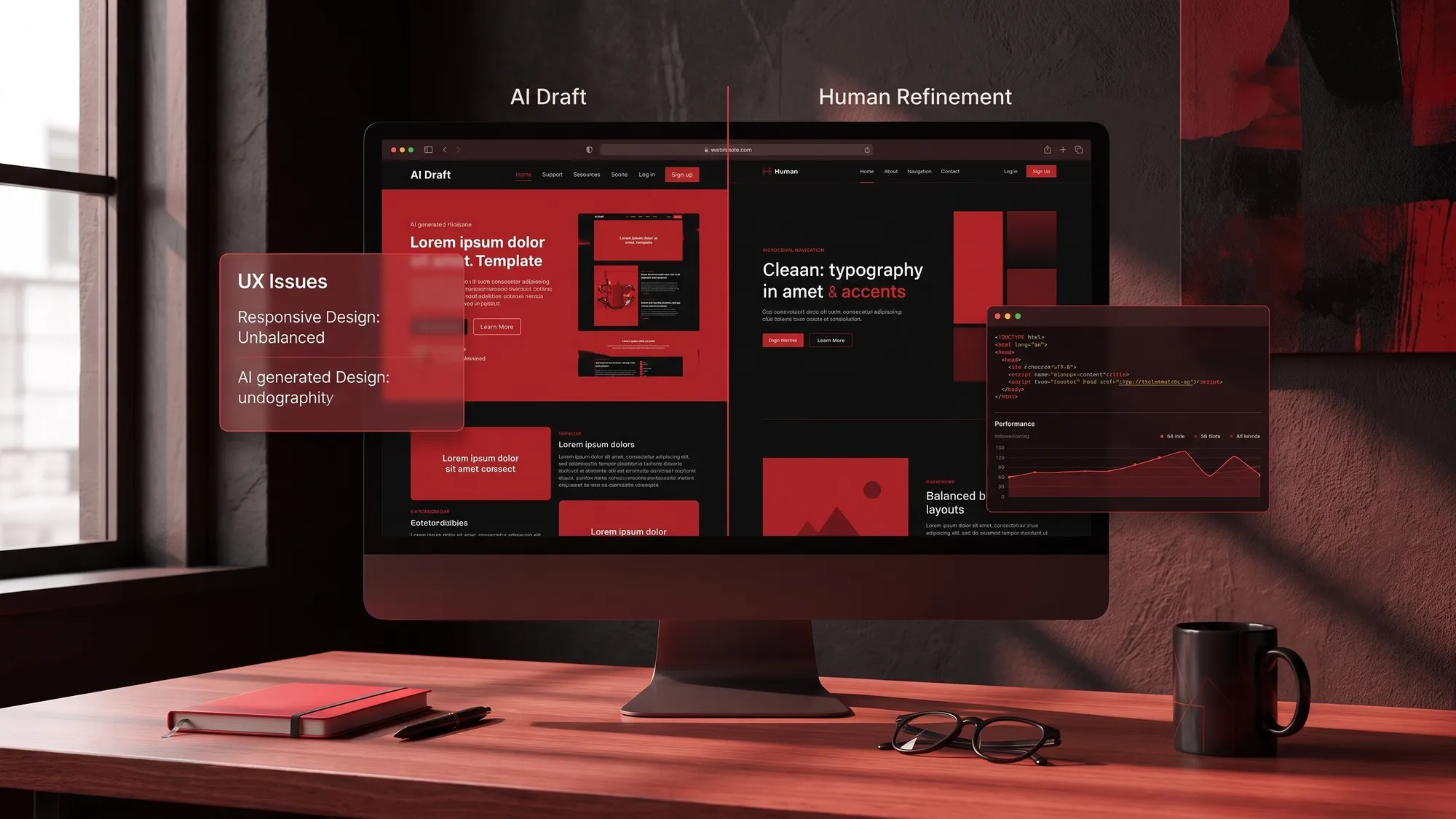
There has never been an easier time to build a website. With tools such as ChatGPT, Claude, Lovable and other AI-powered website builders, you can now take an idea and turn it into a functioning website without necessarily having a background in design or development. For small businesses, entrepreneurs and even established companies, this opens up opportunities that were previously much harder to access.
I think that is a positive development. I use AI myself and it has become an important part of the way I work. It allows me to explore ideas, prototype concepts, generate code and move through development much faster. The difference is that I do not treat what AI produces as the finished product. There is usually another stage where the work needs to be reviewed, challenged and refined by someone who understands web design, user experience, development and the business objectives behind the website.
This is becoming particularly relevant as more businesses start launching websites that have been created almost entirely with AI. Some of these websites look genuinely impressive when you first see them. The layouts are modern, the animations are polished and the overall presentation can be very convincing. However, once you start using the website properly, you often find issues that are not immediately visible in a screenshot. The mobile experience may not have been properly considered, the navigation might be confusing, the content can feel generic, the SEO structure may be weak, and the website may contain unnecessary code or functionality.
AI is a powerful starting point, but it still needs direction
One of the biggest misconceptions around AI website development is that if an AI tool can generate a working website, the website is therefore professionally finished. In reality, generating the website is often only the beginning.
A good website requires decisions that go beyond whether a particular component looks good. The structure needs to make sense for the people visiting the website. The content needs to communicate the right information in the right order. The navigation should be intuitive. Calls to action need to appear naturally within the customer journey. The design needs to work across different devices, and the technical implementation needs to be reliable enough to maintain and develop over time.
AI can help with many of these areas, but it does not automatically understand the specific context of your business or your customers. It can follow a prompt very well while still producing something that is not particularly effective. This is where experience becomes important. A professional designer or developer is able to look beyond whether the website works and consider whether it works well.
Why some AI-generated websites look the same
Another issue I have noticed is the growing similarity between AI-generated websites. Many tools are trained on existing design patterns, and the results can therefore gravitate towards familiar visual styles. Large typography, gradients, glass effects, floating cards, dark backgrounds, oversized buttons and elaborate animations can all produce a visually impressive result, but when the same combinations appear repeatedly, websites start to lose their individuality.
There is nothing wrong with using these techniques when they are appropriate. The problem is using them simply because they are currently popular or because the AI suggested them. A professional website should reflect the character of the business rather than the default aesthetic of an AI website builder.
This is one of the areas where I can make a significant difference to an AI-generated website. Rather than starting again, I can take the existing design and identify where it feels generic, where the visual hierarchy could be improved and where the experience could be made more distinctive. Sometimes that means introducing a completely different visual direction. In other cases, it is simply a matter of removing unnecessary elements and giving the existing design more clarity.
Good web design is not about adding as much as possible. It is about making the right decisions.
A website can look good and still have problems
Visual quality is one of the easiest things to judge when reviewing a website. You can immediately see whether you like the colours, typography, imagery and overall style. UX and technical quality are more difficult to recognise unless you have experience working with websites.
For example, an AI-generated website might have a beautiful homepage but make it unnecessarily difficult for visitors to find important information. A form might look good but contain too many fields. A mobile menu might technically work but be awkward to use. A page might contain several calls to action without giving the visitor a clear reason to choose any of them.
The same applies to the technical implementation. AI can generate code that works while still being unnecessarily complicated. It can create duplicated components, introduce libraries that are not required, generate excessive JavaScript or structure a project in a way that becomes difficult to maintain. None of this necessarily causes an immediate problem, but it can make future changes slower, more expensive and more complicated.
This is why I believe AI-generated websites should be treated in much the same way as any other first version of a website. They need to be reviewed before being considered finished.
SEO needs more than AI-generated content
Search engine optimisation is another area where I often see opportunities for improvement. AI makes it very easy to generate SEO titles, meta descriptions, headings and large amounts of website content, but simply generating those elements does not create an effective SEO strategy.
A well-optimised website needs a logical structure that search engines can understand and visitors can navigate easily. Page titles, headings, URLs, internal links, metadata, structured data, image optimisation, page speed, mobile performance and indexing all contribute to the technical foundation. The content itself also needs to demonstrate genuine value rather than simply containing keywords.
AI can be extremely useful for researching topics, structuring information and helping to produce content, but the final website still needs to be reviewed against the actual business and its audience. Generic content can make a website sound like every other company in the same industry, which is particularly unhelpful when the objective is to establish credibility and differentiate the business.
For businesses investing in an AI-generated website, this is an area worth addressing before launch rather than trying to fix everything later.
SEO is not my primary area of expertise, but I can connect you with trusted professionals who can provide a comprehensive SEO audit and recommend the right services based on your specific needs.
Mobile performance and accessibility are easy to overlook
A website that looks good on a desktop screen is not necessarily a well-designed website. Mobile users interact with websites differently, and elements that work perfectly on a large screen can become difficult to use when they are compressed into a much smaller layout.
AI tools can generate responsive layouts, but responsive does not always mean well designed. Typography, spacing, navigation, forms, images and interactive elements all need to be considered at different screen sizes. Performance is also important because unnecessary animations, large images, scripts and third-party libraries can make a website slower than it needs to be.
Accessibility is another consideration that can easily disappear during a rapid AI-assisted build. Proper heading structures, colour contrast, keyboard navigation, form labels, alternative text and appropriate focus states all contribute to making a website easier to use.
These areas may not be the first things someone notices when looking at an AI-generated website, but they have a direct impact on the quality of the experience.
You may not need to rebuild your website
If you have already built your website using AI, I would not automatically recommend starting again. In many cases, there is a perfectly good foundation underneath the problems.
The more sensible approach can be to review what you already have and identify what genuinely needs to change. I can assess the website from a design, UX, technical, SEO, performance and accessibility perspective and determine where improvements will have the greatest impact.
Sometimes the changes are relatively straightforward. A section may need restructuring, the typography may need refinement, the mobile layout may need fixing or the navigation may need simplifying. In other situations, the underlying implementation may need more substantial work. The important thing is to understand the problem before deciding on the solution.
This approach is particularly useful for businesses that have used AI to get a website online but have reached the point where they realise it does not quite feel finished. You have already done the difficult part of getting the idea into a working product. Professional refinement can then take it to the next level.
Bringing an AI-built website up to professional standards
This is where I can help. I work with businesses that have built websites themselves, with AI or otherwise, and need an experienced perspective to take the project further. I can review the existing website and identify issues across the user experience, visual design, responsive behaviour, SEO, accessibility, performance and technical implementation.
The objective is not to remove the AI from the process. It is to make sure the final result benefits from both the speed of AI and the judgement that comes from professional experience.
A website should be designed around the business and its customers, not around the limitations or default behaviours of the tool that was used to create it. If an AI tool helped you build the first version, there is no reason that version cannot become the foundation of a much stronger website.
AI is changing web development, and that is a good thing
I do not see AI as a threat to professional web design and development. I see it as another tool that is changing how we work. The ability to prototype quickly, experiment with different approaches and reduce the time required to implement ideas can make the entire process more efficient.
What is changing is the role of the designer and developer. There is less value in simply writing every line of code manually or creating every initial concept from scratch. There is more value in understanding what should be built, why it should be built, how it should work and whether the final result actually solves the problem it was intended to solve.
That is why the most effective approach is often a combination of AI and professional expertise. AI can accelerate the production process, while experience provides the strategy, design judgement, technical oversight and attention to detail required to turn that output into a website that is genuinely ready for customers.
If you have already built your website using AI, you do not necessarily need to start again. You may simply need someone to review what you have, identify the weaknesses and bring it up to modern web design and development standards.
If your AI-generated website feels unfinished, looks too generic, does not perform as well as it should or simply needs a professional eye, I can help fix it and take it to the next stage.
- AI website
- AI-generated website
- AI web development
- AI web design
- AI website builder
- website development
- web design
- UX design
- website optimisation
- SEO
- technical SEO
- website performance
- responsive web design
- accessibility
- AI development
- professional website
- web development Mauritius